
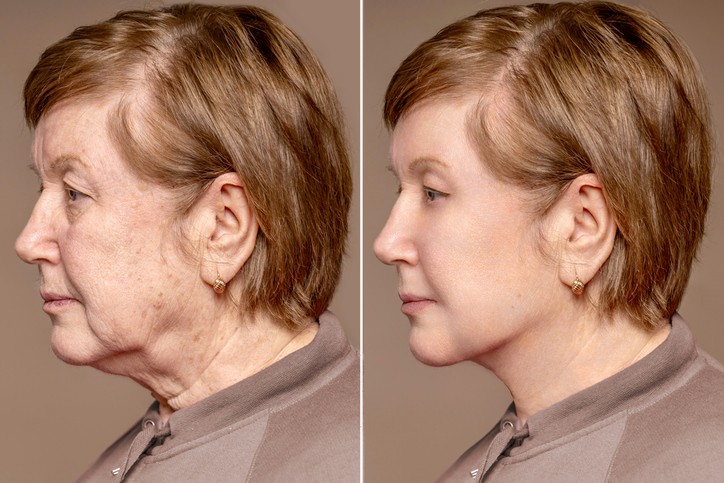

What is a Deep Plane facelift?
A Deep Plane facelift is a facial rejuvenation technique designed to reposition deeper facial tissues rather than relying primarily on tightening the skin.
Over time, facial ageing affects several anatomical layers as say lifting facial Barcelona clinic
The skin changes, but so do fat compartments, ligaments and deeper supporting structures.
For this reason, modern facelift surgery increasingly focuses on repositioning the structures beneath the skin rather than simply pulling the surface tighter.
The objective is a more natural rejuvenation of the face.
For patients researching a Deep Plane facelift in Barcelona, understanding what the technique actually does is more important than simply choosing it because it is popular.
How does the face age?
Facial ageing is not caused by one single factor.
Different changes occur simultaneously.
These may include:
- loss of skin elasticity;
- descent of facial tissues;
- changes in fat distribution;
- weakening of facial support structures;
- loss of jawline definition;
- development of jowls;
- changes in the cheek area;
- neck laxity.
This is why a skin-only approach may not fully address more advanced facial ageing.
How is a Deep Plane facelift different?
Traditional facelift techniques can involve different levels of tissue manipulation.
The Deep Plane approach works beneath the superficial muscular and fascial layers of the face.
Rather than applying most of the tension to the skin, deeper structures are mobilised and repositioned.
This can allow the surgeon to address areas such as:
- midface descent;
- jowls;
- jawline;
- lower face;
- selected neck concerns.
The exact surgical plan varies according to anatomy.
Does Deep Plane mean a more dramatic result?
Not necessarily.
“Deep” refers to the anatomical plane in which the surgeon works, not to how aggressive or obvious the final result should appear.
In fact, one of the aims of Deep Plane surgery is to create rejuvenation through repositioning rather than excessive surface tension.
A successful result should ideally make the face appear more rested and defined without looking surgically stretched.
Why can the result look more natural?
Artificial-looking facelift results are often associated with excessive tension or alteration of natural facial proportions.
When deeper tissues are repositioned appropriately, the overlying skin can follow the new structure with less reliance on pulling.
This may help maintain more natural facial movement and contours.
However, the technique alone does not guarantee a good result.
The surgeon’s judgement remains fundamental.
Who may be a candidate for a Deep Plane facelift?
There is no exact age.
The indication depends on the degree and pattern of facial ageing.
A patient may consider surgical rejuvenation when they have:
- noticeable jowls;
- loss of jawline definition;
- descent of cheek tissues;
- lower facial laxity;
- changes that no longer respond sufficiently to non-surgical treatments.
A consultation is necessary to determine whether surgery is appropriate.
Can non-surgical treatments replace a Deep Plane facelift?
In mild ageing, non-surgical options may provide meaningful improvement.
Treatments can help with:
- skin quality;
- fine lines;
- mild laxity;
- pigmentation;
- texture.
But they cannot always reproduce the structural repositioning achieved by surgery.
When tissues have descended significantly, adding more non-surgical treatments may provide limited benefit.
The key is recognising when the problem has moved from skin quality to structural ageing.
Does Deep Plane facelift include the neck?
It can, depending on the patient’s needs and the surgical plan.
Facial and neck ageing are often related.
A patient may have good cheek volume but significant jawline and neck laxity.
Another may show greater midface descent.
The procedure should therefore be customised rather than performed as a fixed template.
Can it be combined with blepharoplasty?
In selected patients, yes.
Facial ageing may also affect the eyelids.
When both areas require treatment, facelift surgery and blepharoplasty can sometimes be planned together.
Other procedures may also be considered depending on the patient’s anatomy.
However, more procedures do not automatically mean a better result.
Each addition should have a clear indication.
What is recovery like after a Deep Plane facelift?
Recovery varies between individuals and according to the extent of surgery.
Early symptoms may include:
- swelling;
- bruising;
- tightness;
- temporary numbness;
- facial sensitivity.
Most patients should expect the result to evolve gradually.
The face often looks different during the first few weeks because of swelling.
Final refinement continues over time.
How long does a Deep Plane facelift last?
No facelift can stop ageing.
The tissues will continue to change with time.
However, surgically repositioning facial structures can create a long-lasting improvement.
Genetics, sun exposure, lifestyle and skin quality all influence future ageing.
Is Deep Plane always the best facelift technique?
No single technique is automatically best for every patient.
This is an important point.
The popularity of Deep Plane surgery should not replace individual assessment.
Some patients may benefit from it.
Others may require a different surgical approach.
The technique should be chosen according to the patient’s anatomy, not because it is trending online.
Choosing a Deep Plane facelift surgeon in Barcelona
When researching a surgeon, look beyond the name of the technique.
Consider:
- experience in facial surgery;
- natural-looking results;
- variety of cases;
- understanding of facial anatomy;
- realistic explanations;
- postoperative follow-up.
A skilled surgeon should also be able to explain why Deep Plane surgery is appropriate — or not appropriate — for your specific face.
Deep Plane facelift in Barcelona: reposition, don’t simply tighten
The central idea behind modern facelift surgery is not to create a tighter face.
It is to restore better facial positioning while preserving identity.
If you are considering a Deep Plane facelift in Barcelona, the consultation should focus first on your anatomy, degree of tissue descent and the areas that contribute most to facial ageing.
The best technique is not necessarily the newest or most popular one.
It is the one that allows the surgeon to achieve the most natural and proportionate result for your face.
Leave a Comment